
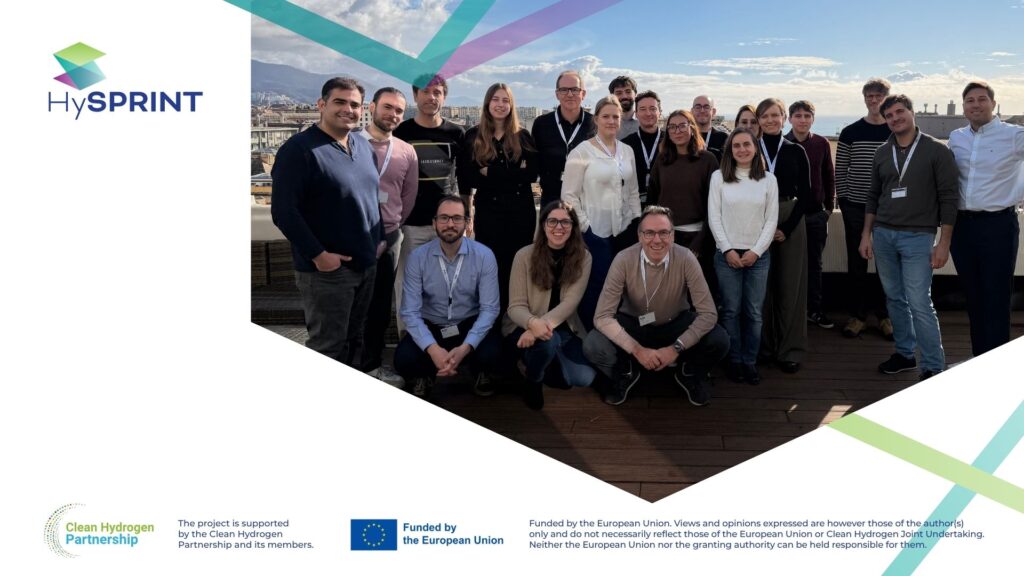
The HySPRINT project, known as: Hydrogen Scale-up and Production through Innovative high-temperature SOEC manufacturing techniques optimized with AI and Quality control Tools to enhance scalability and minimise scrap rates, officially kicked off on 28 January 2026.
The project is funded by the European Union under the call HORIZON-JU-CLEANH2-2025, Grant Agreement No. 101250891, with the Clean Hydrogen Joint Undertaking as the granting authority. The project is supported by the Clean Hydrogen Partnership and its members.
The project brings together nine partners from across Europe, will run for 36 months, and is coordinated by RINA Consulting S.p.A.
About the HySPRINT Project
HySPRINT aims to advance clean hydrogen technologies by improving the manufacturing of Solid Oxide Electrolysis Cell (SOEC) components. The project focuses on making production processes more sustainable, cost-effective, scalable, and easier to recycle, while reducing waste and scrap rates. By combining innovative manufacturing techniques with automation, artificial intelligence, and advanced quality control tools, HySPRINT aims to improve the production and scalability of SOEC components for clean hydrogen applications.
About the Consortium
The HySPRINT consortium consists of nine partners spanning different industrial and research niches across Europe, led by RINA Consulting S.p.A. (Italy). Part of the consortium are also SolydEra S.p.A. (Italy), Fundació Eurecat (Spain), Fundació Institut de Recerca en Energia de Catalunya (Spain), AEA s.r.l. (Italy), F6S Network Ireland Limited (Ireland), Torrecid S.A. (Spain), Dynelectro ApS (Denmark), and Università degli Studi dell’Aquila (Italy). The consortium brings together industrial partners, research organisations, and innovation support actors from across Europe.
Kick-Off Meeting
The HySPRINT project was officially launched with a two-day kick-off meeting held on 28-29 January 2026 in Genoa, Italy, hosted by the project coordinator RINA Consulting S.p.A.
During the meeting, consortium partners met in person for the first time and presented the scope of their activities, planned contributions, and technical objectives across the project’s 12 work packages. The meeting enabled alignment on the project vision, implementation strategy, and collaboration framework. The consortium expressed its appreciation to RINA Consulting S.p.A. for successfully hosting and coordinating the kick-off meeting.
Project Approach
The goal of the HySPRINT project is to use innovative manufacturing techniques for cell components to make them more sustainable, cost-effective, and easier to recycle.
The project will bring together three advanced production techniques: 1) Inkjet printing for the oxygen electrode 2) Physical Vapor Deposition (PVD) magnetron sputtering for the barrier layer and 3) Optimisation of the proprietary ReScale method for producing the steam electrode and electrolyte.
These techniques were selected to ensure a low-impact production process, generating minimal waste and material loss. To further improve durability and performance, thin films will be applied to the components. The manufacturing process will be made increasingly automated and waste-efficient through the use of AI algorithms and a quality control tool called the Advanced Electrode Manufacturing Supervisor (AEMS). Each advanced technology will be scaled up to MRL5, including the production of 300–400 components and an increased active area of 12 × 8 cm².
The assembled cells will be tested to validate their performance in a relevant environment at TRL6. To simulate the scale-up of a 5 kW stack, a dedicated test bench will be implemented, and feasibility assessments for larger-scale stacks of up to 30kW will be carried out.
From a sustainability and circularity perspective, HySPRINT will define eco-design and design-for-recycling guidelines to enable easy disassembly and recycling of cells. The sustainability of the components will be further enhanced by reducing the presence of Critical Raw Materials (CRMs), increasing the share of recycled materials, and defining effective waste recycling approaches.
Alignment with Clean Hydrogen Joint Undertaking Objectives
HySPRINT follows the objectives of the Clean Hydrogen Joint Undertaking, which are to:
- Support the implementation of the Commission’s Hydrogen Strategy
- Stimulate research and innovation on clean hydrogen production, distribution, storage and end use applications
- Strengthen the competitiveness of the EU clean hydrogen value chain
- Contribute to the EU ambitious 2030 and 2050 climate ambition including the Green Deal
Through its focus on advanced SOEC manufacturing, scalability, automation, circularity, and waste management, HySPRINT contributes to these objectives.
Message from the Project Coordinator
RINA is proud to coordinate the HySPRINT project, an ambitious European initiative dedicated to advancing clean hydrogen technologies through improved manufacturing of Solid Oxide Electrolysis Cell (SOEC) components and to work with a strong consortium composed of nine relevant organisations representing various sectors, including industry, research, and innovation support, from across Italy, Spain, Ireland, and Denmark. HySPRINT directly supports the objectives of the Clean Hydrogen Joint Undertaking by strengthening Europe’s hydrogen technology sector. The project aligns with the European Commission’s Hydrogen Strategy and contributes to broader climate goals, including the 2030 and 2050 targets and the European Green Deal. Through collaboration, innovation, inclusion of AI technologies through the development of a quality control tool, and a clear focus on sustainable manufacturing, HySPRINT is poised to make a meaningful impact on the future of clean hydrogen in Europe.